Saturday, September 17, 2011

Birthday of the U.S. Constitution

Happy (224th) Constitution Day!
Constitution Day, formally known as Citizenship Day, is the holiday that marks the formal adoption of the the U.S. Constitution.and recognizes those who have become citizens. With a political climate hostile to both constitutional principles and new citizens, it’s worth a moment to reflect on what we should be celebrating.
The Constitution is more than a governing document. It’s an expression of cultural and political values and ideals that help define what it means to be an American. Taken out of the vacuum of political ideology, the Constitution embraces the belief that individuals should have a check, and a remedy, against the abuse of police power, that all persons have a unique and equally worthy humanity that the law should respect and that the essential function of the government is to provide for the common good.
It established three co-equal branches of government to divide power and force compromise in order to govern. It allows for a balance between accountability to the electorate and the flexibility necessary to govern and disperses influence, albeit imperfectly, across a nation vast in geography and differing opinions.
As good as it is, the Constitution is not perfect. Indeed, until amended it failed to recognize the humanity of African-Americans, women, and anyone not a white male property owner. It still does not explicitly provide for a recognition of women as equal rights holders as men and is vague enough to pluck out corporate personhood from its meaning.
Yes, it remains a work in progress. But in the meantime let’s celebrate the fact that it guarantees citizens full due process and equal protection under the law, free speech, privacy and liberty rights and remains, to this day, a model of how one of the greatest political experiments in mankind’s history got it mostly right.
This is the "birthday" of our marvelous Constitution of the United States of America! Let us give thanks for it!
There have been countless forms of government throughout the history of mankind. But the Constitution has proved to be far superior to any other charter of human government in promoting what the Declaration of Independence labeled as our "unalienable rights" of "life, liberty and the pursuit of happiness."
It was almost miraculous that on this date Sept. 17 in the year 1787, an assembly of men in Philadelphia managed to come to agreement on the Constitution, which the states would later ratify.
The Constitution is the basis of the liberty and justice that we enjoy in the United States. It is a brilliant balance of powers -- and restrictions on power -- and it promotes the best interests of our free people in this blessed nation.
Despite our individual imperfections and despite occasional challenges, violations and stresses in war and peace throughout centuries, the Constitution has survived.
Is it perfect?
Times change. Challenges vary. But among the Constitution's virtues is the orderly, cautious process that it provides to amend it, if we feel a need to do so. The prescribed process prevents us from falling victim to sudden passions and partisan whims, which might otherwise allow us to undermine our cherished freedoms in pursuit of an unwise or short-term goal.
We, the people, by our Constitution, have delegated specific powers to the federal government -- with the 10th Amendment reserving all others to the states or the people. That important provision has helped us to preserve liberties that most people outside the United States do not enjoy.
What if we didn't have the Constitution? Can you imagine what we might do, today, if we "started from scratch," to attempt to write a new Constitution?
Do you believe we could do as well as the men who gathered at the Constitutional Convention in 1787? We doubt it!
But if you're not sure, just sit down and try to write the kind of Constitution you think might be better. Could you devise surer guarantees of personal freedom? Could you provide better means for our nation to exercise needed governmental power -- but not too much power?
Whatever the Constitution's imperfections may be, the real danger in government today is not that we will adhere "too closely" to it, but that we will not adhere to it as carefully and specifically as we should!
We should resolve, therefore, to defend and uphold the Constitution, to treasure it and honor it -- and to preserve it for ourselves and future generations.
Today, on the birthday of the Constitution, all of us Americans should be humbly grateful for that enduring document -- and for the "blessings of liberty" that it secures for us.
Wednesday, September 14, 2011
On This Day.........

The original Star-Spangled Banner, the flag that inspired Francis Scott Key to write the song that would become our national anthem, is among the most treasured artifacts in the collections of the Smithsonian’s National Museum of American History in Washington, D.C.

Check out more of what happen on this day and check out the Smithsonian website, click link below:
http://www.si.edu/Encyclopedia_SI/nmah/starflag.htm
Saturday, May 28, 2011
Happy Memorial Day to ALL!
Please watch this video dedicated for all U.S. soldiers, who have and are serving currently:
http://www.youtube.com/watch?v=Q65KZIqay4E&feature=player_embedded
GOD BLESS THE USA!
Monday, December 6, 2010
December 7th - A Day for Remembrance

December 7th 1941 : Japanese Surprise Attack On Pearl Harbor


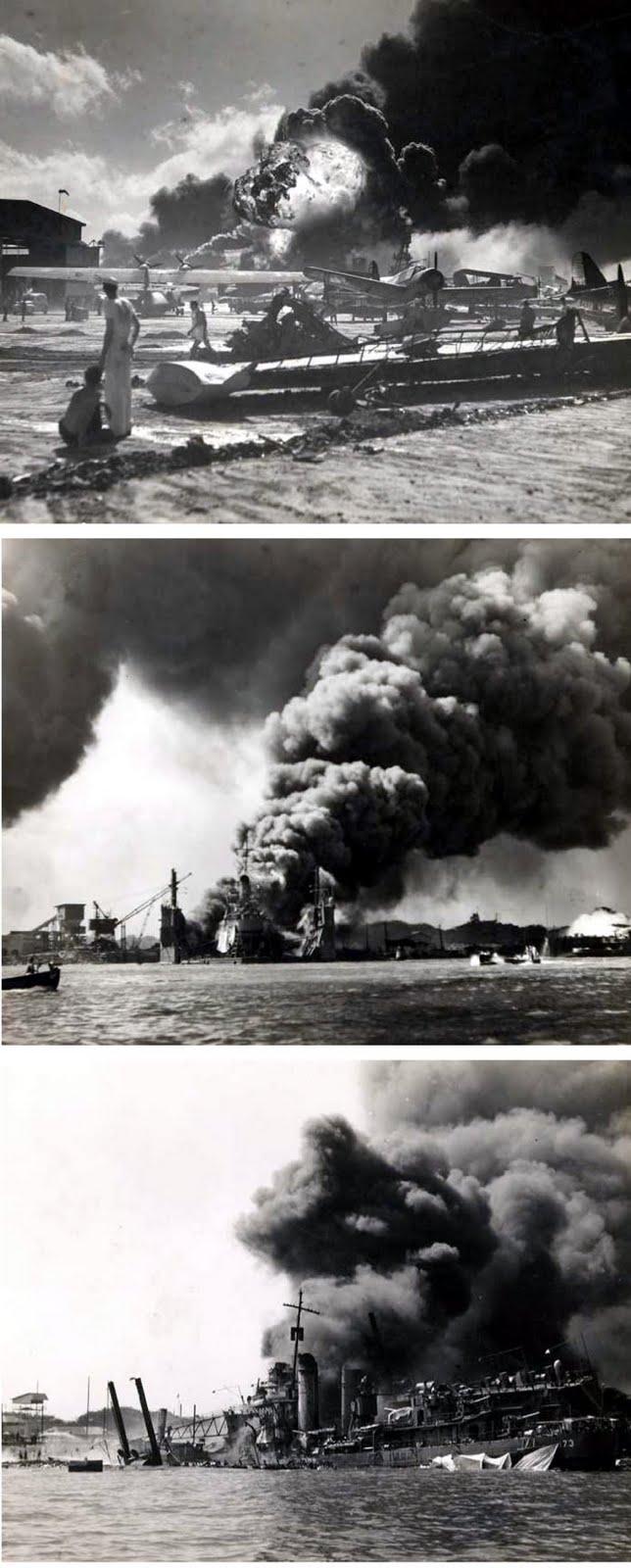
The carefully planned raid by sea and air deals a severe blow to US Navy, sinking many battleships, destroyers, and auxiliary ships as well as destroying many aircrafts. The raid is a success, but the prize target, the US aircraft carriers are not present and would later take part in the battles of the Coral Sea and Midway.
In the aftermath of the battle the commander Admiral Yamamoto said "We have awaken a terrible giant".

Here are movies :
Attack On Pearl Harbor, part of a documentary using most footage from the movie "Tora! Tora! Tora!"
To watch click on the links:
http://www.youtube.com/watch?v=Nt13c3olXkU
http://www.youtube.com/watch?v=HAnOtWm5OrM

Here is President Franklin Delano Roosevelt - Pearl Harbor Address, click on the link below:
http://www.youtube.com/watch?v=3VqQA f74fsE

Here is a video clip I found about Pearl Harbor attack. It's pretty good and it uses clips from the movie "Pearl Harbor" (2001).

The movie is based around love, friendship, honor, courage, and the historical accounts of the attack on Pearl Harbor. In the movie near the end shows the depiction of the surprise Japanese attack on Pearl Harbor. It's very real and feels like you are there experiencing it. Even some Pearl Harbor veterans of that infamous day saw the film had to leave or left the movie in tears. So, I recommend this video for people over the age of 18 years old. I get emotional watching these video clips from America's past. Let me know what you think of it:
http://www.youtube.com/watch?v=YAF2GgiduvM
Links to some sites that dedicate the facts, pictures, and stories of December 7, 1941:
http://the.honoluluadvertiser.com/article/2004/Dec/08/ln/ln10p.html
http://www.rivervet.com/pearl_harbor.htm
http://www.coolcrack.com/2009/12/incredible-pictures-of-pearl-harbor.html
http://www.veteran.com/content/pearl-harbor-memorial-2007
http://www.december7.com/1941/Ewa_Field_2010/index.html
http://www.nationalgeographic.com/pearlharbor/
http://www.pitt.edu/~goldy/library.html
http://groverandgoni.blogspot.com/2009/09/hawaii-adventures-3-pearl-harbor.html
http://www.buglerusn.us/ww2_quotes.htm
http://www.uss-pollack.org/ss180.html


FYI: Just click on pictures to enlarge the photos. Enjoy!


Sharlot Hall Museum Photograph Call Number:(USS Arizona afire, NPS) Reuse only by permission.
The USS Arizona, December 7, 1941, afire at Pearl Harbor. The ship sank with 1,102 sailors entombed that day. An additional 75 crew members died and a mere 334 men survived the attack by the Japanese. The death toll on the USS Arizona was nearly half of all personnel killed at Pearl Harbor (1177 of 2402).

Sharlot Hall Museum Photograph Call Number:(USS Arizona Memorial, NPS) Reuse only by permission.
USS Arizona Memorial, dedicated in 1962 at Pearl Harbor welcomes over a million visitors every year.

This post is dedicated to all who either died or survived this day 69 years ago at Pearl Harbor, Hawaii.
Tuesday, November 30, 2010
Early American Flag History

The United States Flag is the third oldest of the national standards of the world; older than the Union Jack of Great Britain or the tricolor of France. "Old Glory" was first authorized by Congress June 14, 1777. This date is now celebrated throughout the Nation by the observation of Flag Day.
The flag, which had 13 stripes alternations red and white representing the 13 states and the rectangular blue field with 13 white stars forming a circle within it was a development of several flags, which had been used in early Revolutionary battles. It was first decreed that there should be a star and stripe for the early state, making 13 of both; for the States, at that time, had just been formed from the original 13 colonies. The colors of Old Glory may be thus explained:
The red for valor, zeal and fervency; white for hope, purity, cleanliness of heart and rectitude of conduct; the blue, the color of the sky, epitomizing heaven for reverence to God, loyalty, sincerity, justice and truth.
The stars (an ancient symbol of India, Persia and Egypt) symbolize dominion and sovereignty, as well as loyal aspirations. The constellation of the stars within the Union, one star for each State, is emblematic of our Constitution, which leaves to the States their individual sovereignty except as to rights specifically delegated to the Federal government.
Old Glory is said to have been flown for the first time on June 15, 1777, near Bound Brook, New Jersey, over Washington's Headquarters and to have been first under fire in the Battle of Oriskany, August 6, 1777. It first flew over foreign territory on January 28, 1778 at Nassau, Bahama Islands, Fort Nassau having been captured by the Americans in the War of Independence. The first foreign salute to the flag was offered by the French Admiral LaMotte Piquet off Quiberon Bay, February 13, 1778.
In 1795, after admission of Vermont and Kentucky to the Union, the number of stars and stripes was raised to 15. As other states were admitted to the Union during the next few few years it became impractical to add both stars and stripes. Congress, therefore, passed an act on April 14, 1818, restoring the 13 alternate red and white stripes as representing the 13 original states and provided for addition of one star for each state upon its admission to the Union.
The last addition to the American flag was made July 14, 1912, when two stars were added---one for Arizona and one for New Mexico---bringing the number to 48. Of course since than there have been 2 more stars added with Alaska and Hawaii entering the Union.
As the manner in which the stars were to be arranged in a Blue field was not decided by Congress. It was determined jointly by the Secretary of Defense and the Secretary of the Navy with the approval of the President of the United States.
The name "Old Glory" was given to our national flag August 10, 1831, by Captain Wm. Driver of the Brig Chas. Doggett.
Old Glory symbolizes national independence and popular sovereignty. It is not the flag of a reigning family or royal house but of a hundred million free people welded into a nation, one and inseparable, united not only by community of interest but by vital unity of sentiment and purpose; a nation distinguished for the clear individual conception of its citizens alike of their duties and their privileges, their obligations and their rights.
Old Glory incarnates for all mankind the spirit of Liberty and the glorious ideal of human freedom; not the freedom of unrestrained or the liberty of license, but a unique ideal of equal opportunity for life, liberty and the pursuit of happiness, safeguarded by the stern and lofty principles of duty, of righteousness and of justice and attainable by obedience to self-imposed laws.
Floating from the lofty pinnacle of American idealism, it is a beacon of enduring hope, like the famous Bartholdi Statue of Liberty enlightening the world, to the oppressed of all lands. it floats over a wondrous assemblage of people from every racial stock of the earth whose united hearts constitute and indivisible and invincible force for the defense and succor of the down-trodden.
Old Glory embodies the essence of patriotism. its spirit is the spirit of the American nation. Its history is the history of the American people. Emblazoned upon its folds in letters of living light are the names and fame of our heroic dead, the Fathers of the Republic who devoted upon its altars their lives, their fortunes and their sacred honor. Twice told tales of national honor and glory cluster thickly about it. Ever victorious, it has emerged triumphant from nine great national conflicts. it flew at Saratoga, at Yorktown, at Palo Alto, at Gettysburg, at Manila Bay, at Chateau-Thierry at Mount Suribachi. It bears witness to the immense expansion of our national boundaries, the development of our natural resources and the splendid structure of our civilization. It prophesies the triumph of popular government of civic and religious liberty and of national righteousness throughout the world.
Old Glory first rose over thirteen states along the Atlantic seaboard with a population of some three million people. Today it flies over fifty states, extending across the continent and over great islands of the two oceans; and over two hundred eighty million owe it allegiance. It has been brought to this proud position by love and sacrifice. Citizens have advanced it and heroes have died for it. it is the sign made visible of the strong spirit that has brought liberty and prosperity to the people of America. It is the flag of all of us alike. Lets remember it and accord it honor and loyalty.
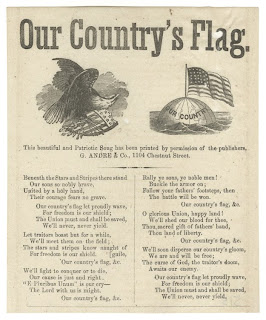
First Stars and Stripes, 1777

For over a year after the signing of the Declaration of Independence, the United States did not have an official flag. Meeting in Philadelphia in June, the Continental Congress declared: "Resolved that the flag of the United States be 13 stripes alternate red and white, that the union be 13 stars white in a blue field representing a new constellation."
No guidelines, however, were provided for the arrangement of the stars, and an amazing number of variations were created. Perhaps the most popular was to arrange the stars in a circle or wreath.
Credit for this design is usually--and mistakenly--given to Betsy Ross. In fact, no clear author of the "first" American flag can be identified, and the Betsy Ross legend was created by the grandson nearly 100 years after the Congressional resolution. Francis Hopkinson represented New Jersey in the Continental Congress, signed the Declaration of Independence and designed seals for various departments of the government and may well have designed the first flag.
Betsey Ross and the first Stars and Stripes
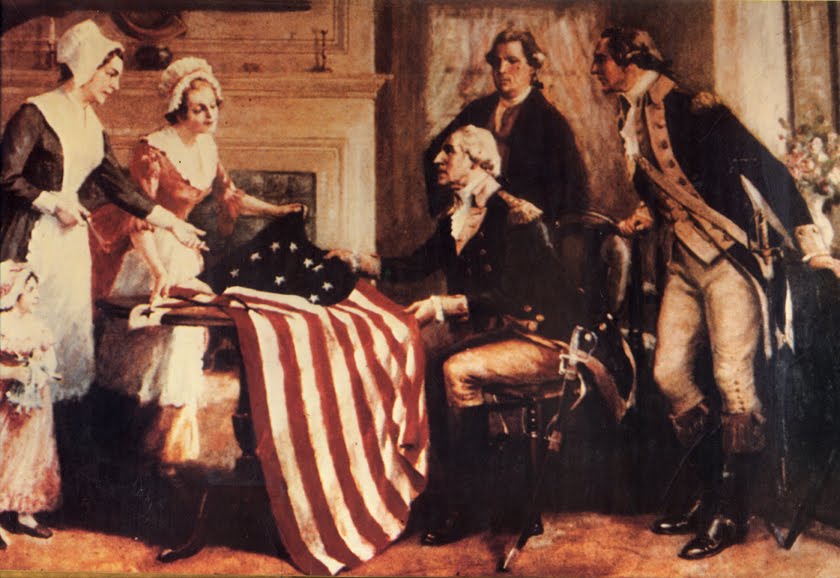
Although there are many conflicting stories regarding this popular picture, it depicts a woman named Betsey Ross, who at the request of a committee headed by George Washington, designed the first authorized American Flag. The first flag had 13 stars symbolizing the thirteen states of the new Republic. Each color in the flag has a specific meaning: red is for hardiness and courage, white for purity and innocence, and blue for vigilance.
The flag, especially the stars and stripes, symbolizes the loyalty and patriotism of the citizens towards their country. The cloth itself signifies little, but the flag as a symbol of the Republic stands for all of the united hopes of the American people, and has become a symbol throughout the world of the desire of all peoples of the world to be free of the yoke of government oppression.

Rare 13 Star Civil War Period Flag


“U” For Union Configuration
American
1861-1865
Rare and Beautiful 13 Star, Civil War Period Flag With A Perimeter Of Stars That Form The Letter “U” For “Union.” Entirely Hand-Sewn And In A Rare Small Size, 1861-1865:
13-star American national flag of the Civil War period (1861-65), entirely hand-sewn and with an exceptionally rare and interesting configuration of stars, the outer perimeter of which forms the letter “U”. Given the date of its making it can be assumed that this stood for “Union”.
The stars of the flag are quite large compared to most 13 star flags of this period, and point in various directions on their vertical axis. This adds one more folk quality to an already fantastic design. Adding to its desirability is the flag’s extremely small size when compared to others of sewn (versus printed) construction that were made during the 19th century, most of which measure between 8 and 20 feet on the fly.
While this flag has no known specific history, both its size and the manner of its making suggest that it may well have seen maritime use, flown from either the stern of a small craft or the pilot house of a larger boat. It wasn’t customary to fly a flag this small in scale, but examples of this size are sometimes encountered and I have always assumed that they existed due to the special request of a ship’s captain or some other high ranking officer.
Flags that have stars that create anything other than a geometric design are extremely rare and highly sought after by flag enthusiasts. A couple of stars patterns are known that actually spell something with numbers or letters, such as two varieties of printed parade flags, one of which has stars arranged to form “1876 - 1776” in celebration of our nation’s centennial of independence and the other that forms the word “FREE” to promote the end of slavery. Very few sewn flags are known that have stars that spell any such thing, but of the few that do, three examples are known that use 44 stars to spell “U.S.” and another is presumed to form the same two letters, although crudely, with 13 stars. A single 48 star example also exists which has stars that spell out “U.S.A.”.
In addition to the above examples, I have seen a handful of Civil War era flags that have a perimeter of stars that forms a “U”, like this flag, although in different fashions. One of these has a single center star, surrounded by a wreath of stars, all of which are contained within a curve of stars that forms the letter “U”. Another of these has 33 stars and contains an arch that was either intended to be a tombstone, a doorway, or the letter “U”. Those two one-of-a-kind examples are both of sewn construction, but there is also a variety of printed parade flag that has 36 stars with an outer perimeter that forms a “U”. One 34-star example and two or three 36 star examples have surfaced with this star pattern, variations of which also exist in 38 and 42 star parade flags.
Of the aforementioned variations, however, only six in total are sewn examples. This circumstance, accompanied by the fact that the flag is entirely hand-sewn, plus its general overall visual impact and very desirable, small size, make it one of the best Civil War era flags of its kind that I have ever offered for sale.
13 star flags have been used throughout our Nation’s history for a variety of purposes. The U.S. Navy used the 13 star count on small boats, not only in the 18th century, but throughout much or all of the 19th century, particularly the second half. This practice ended in 1916 following an executive order from President Woodrow Wilson. Some private ships also used 13 star flags during the same period as the Navy, and the use of yachting ensigns with a wreath of 13 stars surrounding an anchor, which began in 1848, still persists today. Among other uses, 13 star flags were carried by soldiers during the Mexican and Civil Wars and displayed at patriotic events, including Lafayette’s visit in 1825-26, the celebration of the Nation’s Centennial in 1876, and the Sesquicentennial in 1926.
Construction: The cotton-muslin stars of the flag are hand-sewn and single-appliquéd. This means that they were applied to one side of the canton, then the blue fabric was cut from behind each star, folded over, and under-hemmed, so that one appliquéd star could be visible on both sides of the flag. While some flag enthusiast have pointed to this construction method as a way of conserving fabric and cutting corners (not having to sew another star to the other side), others suggest that the real purpose was to make the flag lighter in weight. I believe it to be a function of all of the above and I always find single-appliquéd stars more interesting for two reasons; one, because they are more visually intriguing and two, because when executed properly they serve as evidence of a more difficult level of seam-work and stitchery., meaning that they are applied to both sides of the blue canton. The canton and stripes are hand sewn of wool bunting and there is a fine linen sleeve with two whipped-stitched grommets.
Thursday, November 18, 2010
Biography of Constitution Signer-
GUNNING BEDFORD, JR. of DELAWARE

Gunning Bedford, Jr., a lawyer and judge, was one of the signers of the United States Constitution for the state of Delaware. After the government of the United States was organized in 1789, Bedford was appointed by President George Washington as the first United States district judge for Delaware.
This distinguished patriot was born in Philadelphia in 1747. His father, Gunning Bedford, Sr., was a Philadelphia architect who served as a captain in the French and Indian War, and also was an alderman in the city of Philadelphia. His mother's maiden name was Susannah Jacquett. He was the fifth of eleven children.
When he was twenty years old, Gunning Bedford, Jr., entered the College of New Jersey, now Princeton University. One of his classmates was James Madison, who later became the "Father of the Constitution" and the fourth President of the United States. Perhaps because he was older than his other classmates, Bedford made an excellent scholastic record, graduating at the head of his class and giving the valedictory address.
Bedford also was different from the other members of his class in that he already was married, and at the graduation ceremony his wife was present with their first baby. His wife was Jane Ballaroux Parker, daughter of the editor of the New York Post Boy. Her father, James Parker, had been an apprentice printer with Benjamin Franklin in Boston, and he and Franklin had exchanged the first silver dollars they ever earned. Franklin's first silver dollar was preserved by Parker and made into a punch strainer that later was given to the Historical Society of Delaware by Bedford's daughter.
After his graduation in 1771, Bedford returned to Philadelphia where he studied law with a prominent attorney, Joseph Reed. About eight years later he moved to Dover, Delaware on August 4, 1779, he was admitted to the bar and began practicing law in Dover.
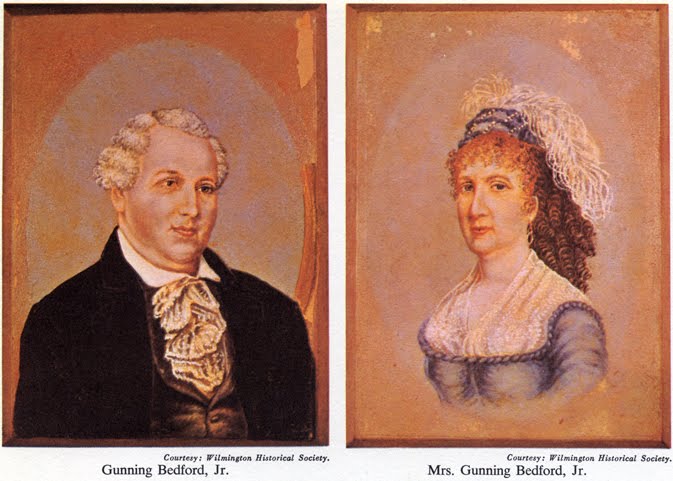

No authentic record has been found of Bedford's activities during the Revolutionary War. However. in the will of his daughter, Henrietta Jane Bedford, filed in 1871, he was described as an "Aide-de-Camp to General Washington in the Revolutionary War." The will left a pair of pocket pistols to the Smithsonian Institution and gave their history as follows: "During the Revolutionary War, General Washington, desiring my father to go from Trenton to New York on some important secret embassy at night, and fearing that he was not sufficiently armed with the pistols in his holsters, presented him with a pair of pocket-pistols with a view to his protection and greater security."
Bedford has sometimes been confused with a cousin five years older than himself who had the same name. This other Gunning Bedford was born in New Castle, Del., in 1742. He had served in the French and Indian War, and had held the rank of major at the beginning of the Revolutionary War. He rose to the rank of lieutenant colonel with a Delaware regiment and was wounded in the battle of White Plains. In 1795, he was elected governor of Delaware and served in that office until his death in 1797.
By the time the peace treaty had been signed with Great Britain in 1783, Gunning Bedford, Jr., was living in Wilmington, Del. That year he was elected as a member of the Continental Congress where he served until 1785. It is not difficult to imagine that considerable confusion arose over the fact that his cousin of the same name also represented Delaware in the Continental Congress during the same period.
On April 26, 1784, Gunning Bedford, Jr., was appointed as attorney general for the state of Delaware. He held this office until 1789, and is said to have served with distinction.
Bedford recognized that the country was in serious difficulty because of the inadequacy of the powers delegated to the national government by the Articles of Confederation, so he was a logical choice as one of Delaware's five delegates to the Annapolis Convention in 1786. That meeting had been called to discuss ways in which trade relationships between states might be improved, and it ended by calling for a Constitutional Convention to revise the Articles of Confederation.
In 1787, Bedford was appointed, with the same delegates who had attended the Annapolis Convention, as a representative of Delaware to the Constitutional Convention in Philadelphia. He became one of the most vocal spokesmen for the interests of the small states against the large states. The forcefulness of his arguments and his eloquence have been credited with being important factors in the decision to give each state two senators in the upper house of the national Congress. When he returned home after signing the United States Constitution, Bedford worked diligently and successfully to have Delaware become the first state to ratify the Constitution.

Bedford devoted the rest of his life to public service. On October 24, 1788, his name was placed in nomination before the legislature to be one of the state's first U.S. senators, but Richard Bassett and George Read, two other signers of the Constitution, were selected instead. The next year, President George Washington, recognizing Bedford's outstanding legal talents, named him as the first United State's district judge for the state of Delaware, a position he held until his death. Newspaper accounts of the times show that Bedford handled one of the earliest cases ever to be tried in a United States federal court-the conviction of a smuggler in May, 1790.
In 1793, Bedford purchased a 250-acre estate near Wilmington which he named Lombardy. There he and his family lived in a large two-story mansion. Bedford died at the age of sixty-four on March 30, 1812. His wife and two children survived him. Buried in the graveyard of the First Presbyterian Church of Wilmington, Del., Bedford's body lies beneath a marble monument whose inscription says in part:
"His form was goodly, his temper amiable,
his manners winning, and his discharge
of private duties exemplary.
Reader, may his example stimulate you
to improve the talents-be they five or two,
or one-with which God has entrusted you."
As a footnote to Bedford's death, it is interesting to read a letter that was sent four days later to Henry M. Ridgely, one of the U.S. senators from Delaware:
"Dear Sir,
"The Wilmington papers which arrived the evening before last, announced the death of Judge Bedford; -this unfortunate event, unfortunate for his family, happened on Monday last. Several of my friends have urged me to an application for the vacancy occasioned by his demise. I have always thought that a personal application for a judgeship, was a matter of indelicacy and inconsistent with the modesty, which such a candidate ought to profess. I have, however, thought on reflecting how the loaves and fishes are now distributed, that there can be but one rival, and but one man, on the same political side, whose pretensions are in any way superior to mine; but in nothing else can I yield to him. . ."
This eagerness for appointment was exhibited by John Fisher, Secretary of State of Delaware, who shortly afterward received Bedford's judgeship by appointment of President James Madison.

